





Week in Review: November 13, 2026
November 16, 2026
Summary
- Nvidia CEO Jensen Huang resigns following allegations of infidelity.
- 3Q26 consolidated S&P 500 earnings growth on pace to be 32%, the third consecutive quarter of 25%+ growth.
- 10-Year Treasury yield rebounds back above 5%.
Overview
Markets ended the week higher, rebounding from the prior week’s post-midterm election selloff. Inflation data, earnings reports, and comments from multiple Federal Reserve officials all vied for investor attention. However, those topics largely took a back seat to news about Nvidia’s co-founder and CEO, Jensen Huang. At the start of the week, allegations surfaced accusing Huang of extramarital affairs, including with a woman suspected of having ties to Chinese intelligence agencies as well as being an executive at a Singapore-based technology firm, one of Asia largest buyers of Nvidia chips. By the end of the week, Huang resigned leaving questions about the company’s future, as well as the broader artificial intelligence (AI) industry, for which he was perhaps the most prominent spokesperson and one of its most ardent supporters. The turmoil at Nvidia also raised national security concerns about the extent to which China may have skirted export controls designed to prevent it from acquiring Nvidia’s most advanced chips, something Congress announced it plans to investigate.
On Tuesday, influential Fed Governor Christopher Waller said he would support an additional 0.25% rate hike at the Fed’s December meeting even if October inflation data improved from September levels. More importantly, Waller intimated the Fed may need to hike rates by 0.50% in December, depending on how inflation trends progress. According to Waller, September’s inflation data was “bad” with “no silver lining.” He said he was “particularly concerned about the breadth of price increases” noting that within the September core personal consumption expenditures (PCE) data, the Fed’s preferred inflation measure, more than 70% of the index’s components experienced a 12-month increase greater than 3%, well in excess of the Fed’s 2% target.
Following Waller’s speech, the release of October inflation data showed headline consumers prices (CPI) rose 0.4% during the month, faster than the consensus expectation for a 0.3% increase, but down from September’s 0.6% increase. Core CPI, excluding food and energy prices, rose 0.3%, unchanged from September’s pace. No year-over-year rates were provided due to the 2025 government shutdown which prevented the collecting of price data. However, using September and November 2025 data to approximate the missing October data suggests headline CPI rose ~4% from a year ago, which would be the fastest annual increase since May, and likely to exacerbate Waller’s concerns.
Producer inflation (PPI) moderated in October, with monthly measures of headline and core PPI both rising 0.3%, down from September’s pace of 1.4% and 0.8%, respectively. Compared to a year ago, headline PPI rose, 6.5%, the fastest pace since November 2022, while core PPI rose 5.0%, matching September’s pace. Due to differences in the methodologies used to collect CPI and PPI data, the government was able to collect price data for October 2025, allowing for year-over-year comparisons.
Oil prices were relatively stable for the week despite President Trump suggesting a deal with Iran to end the current impasse over the Strait of Hormuz might not be necessary. Speaking to reporters on Thursday, Trump said “We don’t need a deal with Iran. Those days have long since passed.” Trump’s comments renewed concerns about the forward path for energy prices.
Through Friday, 91% of S&P 500 companies reported 3Q26 earnings. Thus far, 84% have beaten their consensus estimate. According to industry group FactSet, consolidated S&P 500 earnings growth for the quarter is expected to be 32%.
The Details
Equities
Equity markets rebounded from the election week sell-off with a strong bounce. The S&P 500 and the Nasdaq climbed 2.5% and 2.3%. The less concentrated S&P 500 Equal Weight and Russell 2000 indexes also had a good week, rising 2.4% and 1.4%, respectively, a good sign for the average stock which outperformed in the previous week’s sell-off. The semiconductor component of the S&P 500 rose only 1%. However, it was weighed down by a 13% fall in its largest contributor, Nvidia, while most other semiconductor companies rose significantly off the previous week’s lows.
Equity market headlines were dominated by a reported scandal surrounding the CEO of Nvidia, Jensen Huang. The reports ultimately resulted in the removal of Mr. Huang from his CEO and Board position with the company. As the leader of the industry’s most important company, Huang was the unofficial mouthpiece and standard-bearer for AI with investors, supply chains, and governmental audiences. In the eyes of many investors, Nvidia was unusually dependent on Mr. Huang given the company’s unique management and governance structure, particularly for a company its size. Huang had 60 direct reports, thus lacking much of the middle management from where the next CEO would usually be sourced. This enabled the company to innovate quickly with Mr. Huang at the helm but will present challenges for any successor.
Amidst all the intrigue, it is important to consider what the actual impact could be to the AI investment boom. To start, it is unlikely that there will be a material impact on the quality or availability of Nvidia’s critical chips for some time. The company has 42,000 employees who can keep the trains running on time day-to-day. The CEO’s role is more meaningful, however, with medium-to-long-term strategy, industry and governmental relationships, and capital allocation. Of those responsibilities, capital allocation may be the most important in the near term as Nvidia has assumed a central role in financing various participants in the AI supply chain. Should an interim or new CEO be less comfortable with this activity, it is possible the industry could lose an important source of capital at a time when equity and debt demands are high. The flood of news stories about Mr. Huang in the days since the scandal broke is also revealing internal conversations that include concerns about the company’s financial commitments. Given the tumult with such an important industry figure and company, it is possible AI linked companies now have yet another source of volatility with which to contend.
As expected, the third quarter earnings season has been strong. To date, all 11 sectors are reporting positive revenue and earnings growth, with six reporting double digit earnings growth. Consolidated earnings growth for the S&P 500 is expected to be 32%, heavily influenced by high growth outliers. Nevertheless, the median company is still producing 15% earnings growth, suggesting broad strength. Small cap companies also had a good third quarter, with 12% revenue growth and over 50% earnings growth.
It was encouraging to see equity markets bounce back after the election week sell-off. The economy is solid, consumers are healthy, and corporate fundamentals are outstanding. But with changing state and federal government composition, ongoing uncertainty in the AI landscape, and interest rates again moving higher, it is possible for equity markets to continue to experience volatility into year-end. Current fundamentals remain strong, but there is a lot for investors to digest.
Fixed Income
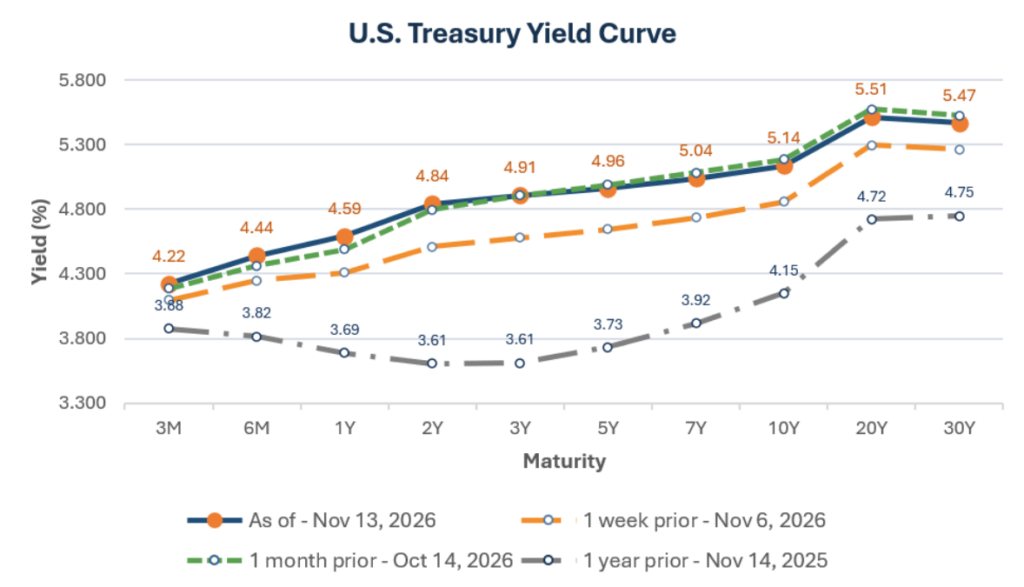
Treasuries posted their worst weekly loss in six months, pressured by October inflation data, hawkish comments from multiple Fed officials, and concerns about what the lack of a deal with Iran might mean for energy prices and future inflation readings. Most weeks, the large moves in the Treasury market would have attracted meaningful attention. However, they seemed to generate limited interest as the headlines largely focused on Nvidia. For the week, the 10-Year Treasury yield rose 0.28% to end at 5.13%, rising back above 5% for the first time since late October and further fueling the debate as to whether the 5% threshold is a new floor or remains a ceiling.
The short end of the curve experienced the largest move, with the 2-Year Treasury yield climbing 0.33% to end the week around 4.85%, as expectations surrounding the timing and size of future Fed rate hikes increased. The primary driver was the “hot” October CPI report along with uniformly hawkish commentary by multiple Fed members. President Trump’s comments regarding a potential peace deal with Iran also played a role. By the end of the week, a 25 bp Fed hike in December was fully priced into the market, with a small probability of a larger 50 bp move, and Fed rate hike expectations for January were demonstrably higher, with a 71% likelihood of a second consecutive hike. The week acted like a reset of the fixed income markets, with the Treasury selloff and domestic rate hike outlook also pushing global yields higher.
Source: Bloomberg
In credit, investment grade issuance continued to be heavy at ~$111B. Pricing remained resilient with IG spreads tightening 3 bps over the week despite Treasury weakness and robust supply. Even with the tightening, returns remained negative as the rates move overwhelmed spread compression.
Munis were almost an exception to the selloff, outperforming significantly on a ratio basis: 10-year municipal yields rose 7 bps on the week versus 28 bps for the 10-year Treasury. Strong November technicals and absolute yield levels protected the market from the full extent of the broader fixed income selloff.
Trust, estate planning, insurance, and investment products are not a deposit, not FDIC insured, not insured by any federal government agency, not guaranteed, subject to investment risks, including possible loss of the principal amount invested and may go down in value. Any information and research contained herein do not represent a recommendation of investment advice to buy or sell stocks or any financial instrument nor is it intended as an endorsement of any security or investment, and it does not constitute an offer or solicitation to buy or sell any securities or investment services. This content is for informational purposes only and does not constitute legal or tax advice. Please consult your legal or tax advisor for specific guidance tailored to your situation. First Western Trust Bank cannot provide tax advice.

Insights
Week in Review: November 13, 2026
Summary Overview Markets ended the week higher, rebounding from the prior week’s post-midterm election selloff. Inflation data, earnings reports, and […]
Learn more
Your 2026 Year-End Wealth Planning Checklist
Now is the time to consider some year-end strategies and to plan for the year ahead. Because everyone’s wealth situation […]
Learn more
November 2026 Market Commentary
October was a busy month, providing investors with a multitude of things to consider including higher energy prices, accelerating inflation, […]
Learn more
How the Blue Wave Crashes on AI
Market Update Midterm election results are in and Democrats achieved one of the largest swings in congressional and state leadership […]
Learn more
Week in Review: November 6, 2026
Summary Overview Markets ended a turbulent week lower following a post-election selloff in which the S&P 500 fell 4.4%, it […]
Learn more
Ready to learn more?
Let’s have a conversation.
Embark on a banking experience tailored to your distinct path, focused on achieving personal and business financial prosperity.