





Week in Review: October 30, 2026
November 2, 2026
Summary
- S&P 500 fell 1.8% on Friday, the largest one-day decline since January.
- The Federal Reserve left rates unchanged following its October meeting.
- Third quarter GDP grew at an annualized rate of 3.4%, up from 2.2% in 2Q26.
- Investment grade corporate bond issuance reached $1.76T for the year, a new record.
Overview
Markets ended the week lower as concerns about AI intensified following disappointing earnings reports from multiple large technology companies. Friday’s 1.8% selloff for the S&P 500 was the largest since January. However, a little context is warranted. Since 1996, the S&P 500 has experienced 314 daily declines of at least 2%, or about 10 per year. In 2026, the S&P 500 has experienced just one thus far, making 2026 unusual in terms of its lack of overall volatility. With so much attention being paid to AI and the vast sums of money being spent to develop it, further downside volatility would not be surprising given how many AI-related stocks are “priced for perfection.”
On Wednesday, the Federal Reserve’s Federal Open Market Committee (FOMC) announced it was leaving its fed funds rate unchanged, a move widely anticipated by markets. The decision was not unanimous as two members voted to increase rates by an additional 0.25%. Speaking at his press conference afterwards, Fed Chair Kevin Warsh continued his practice of providing no forward guidance. He did indicate, however, that in 2027 the FOMC will again meet eight times, but that one of those meetings will be used to focus exclusively on broad monetary policy strategy. As a result, the FOMC will only vote on the federal funds rate seven times in 2027. In 2028, Warsh expects two meetings to be reserved for strategy discussions, leaving six for voting on rates. Market expectations for a December rate hike ended the week at 72%, up slightly from 69% the prior week.
US GDP grew at a 3.4% annualized rate in the third quarter, up from 2.2% in the second quarter, driven by strong consumer and business spending. Equipment spending, which includes spending by AI grew 20.9%, the fastest pace in six years. Interestingly, private inventories saw their largest increase since 1Q25, which some economists attributed to companies preparing for renewed tariff announcement by the administration following the mid-term elections.
Core personal consumption expenditures (PCE), the Fed’s preferred inflation measure, rose 3.1% from a year ago, up from August’s 3.0% pace, keeping pressure on the Fed to raise rates. Following the Fed’s FOMC meeting, Chair Warsh described inflation and “too high” before reiterating that the Fed is committed to returning it to 2%.
Through Friday, 60% of S&P 500 companies had reported third quarter earnings. According to industry group FactSet, thus far, 82% of companies have beaten their earnings estimate. Consolidated earnings growth for the quarter is expected to be 30%. Following, disappointing earnings reports from Alphabet, Amazon, and Meta, Mag 7 earnings growth is now expected to be 23%, down from 34% on September 30. Earnings growth for the other 493 companies is now expected to be 33%, up from 28% on September 30. If that proves correct, it would mark the first time since 4Q22 that the earnings growth of the other 493 companies in the S&P 500 exceeded the Mag 7. The strong earnings growth of the other 493 points to solid corporate fundamentals and underlying economic growth, one reason for the market’s relative stability in 2026.
The Details
Equities
Volatility in equities picked up last week, driven by rapidly evolving views on the AI investment boom. The S&P 500 fell 0.6%, while the technology-heavy Nasdaq fell 2.0%, capped by a 2.9% fall on Friday. The S&P 500 Equal Weight continued to perform better, rising 0.8%. The Nasdaq and S&P 500 Equal Weight finished October with the largest monthly disparity in performance since 2002, with the S&P Equal Weight rising 5.0% while the Nasdaq fell 5.3%. Small cap stocks were also positive for the week, rising 1.3%.
Frontier AI lab Anthropic filed its much-anticipated registration statement (S-1) ahead of its expected IPO. The details within the document bolstered sentiment on AI investment. The company was profitable in the second quarter, has less customer concentration than feared, and has significant room to grow within the expense base of even its largest corporate customers. That momentarily restored confidence in the AI trade, sending the Nasdaq up over 2% through Wednesday and the S&P 500 up nearly 2%.
The good mood did not last. The largest cloud computing companies—Google, Microsoft and Amazon—reported earnings Wednesday and Thursday and spooked investors for various reasons. The cloud results for all three continued to accelerate from already healthy levels. Cloud revenue growth was strong, ranging from near 40% at Amazon to over 100% at Google. While those numbers would seem to validate the need for AI investment, investors were less pleased by the near-term weakening of profitability and free-cash flow as investment continues to ramp. Google also received extra scrutiny due to weakening growth in its cash cow search business. Investors are concerned about the risk of disruption in this business from AI. Thus, any evidence of this disruption, right or wrong, would be met with a severe reaction. Google shares fell 12.6% on Thursday, wiping out $500B of market cap.
While AI related stocks oscillate from one extreme to the next, the rest of the market continues to grind higher, as evidenced by the resilient S&P 500 Equal Weight amidst the sell-off in the market cap weighted S&P 500 and Nasdaq. It is estimated that only 5% of the equal weighted S&P 500 is strongly linked to AI, compared to well over 40% for the market cap weighted S&P 500. Earnings strength is broad this quarter, with all 11 S&P 500 sectors reporting positive earnings growth and seven of the 11 reporting double-digit earnings growth. The broad strength is driving upward earnings revisions for the S&P 500 for the fourth quarter. This has now happened five of the last six quarters and is fairly rare – earnings are usually revised down during earnings season as forward estimates tend to be too optimistic.
With positive earnings continuing to roll in, the S&P 500 is now expected to grow revenue 13% for full-year 2026, generating 33% earnings growth. Expectations for 2027 call for 9.6% revenue growth and a 16% increase in earnings. This would be a strong year on its own but implies a slowdown in growth. Slowing growth tends to cause investor anxiety. Regardless of how high the absolute rate of growth remains, investors inevitably look beyond the near-term to the eventual end of the cycle. This is partly at the root of recent market volatility. As long as growth is accelerating, there is little room for those fears, but with peak growth in the rear-view mirror, it is not surprising investors are preparing for this cycle to conclude. However, with the average company just joining the earnings growth party and demand for AI remaining capacity constrained, there is reason for optimism. Equities have enjoyed a relatively smooth ride in 2026, with subdued volatility. While the road could become more bumpy, it can still go to a better place.
Fixed Income
Fixed income strengthened as investors returned to bonds, even as inflation concerns, expectations for further Fed rate hikes, and heavy issuance remained in focus. The 10-year Treasury yield fell approximately 6 bps to 4.93%, extending the flight-to-quality rally at a more modest pace than the prior week. The Fed held rates unchanged at its midweek meeting but added uncertainty by announcing a reduced decision schedule: eight decisions in 2026, seven in 2027, and six in 2028. Following the Fed’s decision, the 10-year Treasury yield initially rose to 5.03% before reversing sharply as equity market concerns about AI resulted in a risk-off return to bonds.
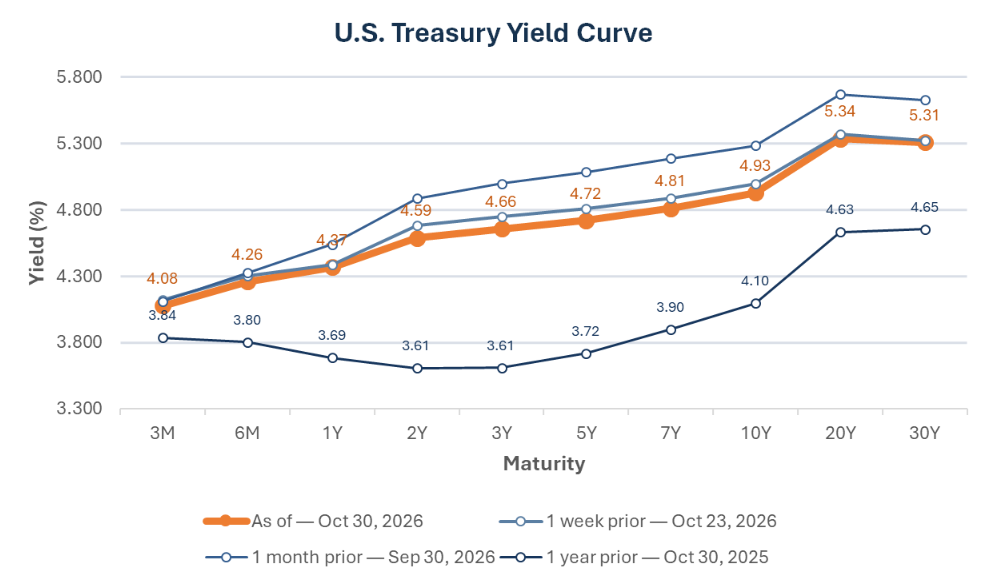
Source: Bloomberg
Since the war in Iran began, rising oil prices and the resulting inflation pressures have pushed bond yields higher. October broke that pattern as oil continued to grind higher while bond yields fell sharply. That decoupling is understood as a flight-to-quality move, with investors seeking safety in bonds despite continued inflationary pressures.
Last week’s central bank meetings left global bond markets facing the same question; not whether October brought a pause, but how much further tightening lies ahead. The Fed, Bank of Japan, and the European Central Bank held rates unchanged, yet markets continued to price in additional hikes from all three before year end. The Bank of England meets this week, with markets pricing in a 95% probability of a hike. In the US, the probability of a December hike stands at ~72%, an expectation that upcoming consumer inflation (CPI) data could reshape. Even with differences in local conditions, the broader story remains a global hiking cycle whose pace and endpoint are unresolved.
Investment-grade (IG) issuance surged in one of the year’s busiest weeks, adding to an already record-setting year. US IG issuance now stands at $1.76T, surpassing the annual record set in 2020, with more than two months remaining in the year. Microsoft returned to the bond market for the first time in nearly a decade with a $25B offering. Attention also turned to the borrowing pipeline. On Monday, SpaceX and Anthropic separately made headlines for large loans to finance AI chips and future computing capacity. Neither deal had priced, but the announcements sharpened IG investors’ concerns about the future borrowing calendar, the scale of financing needs, and potential volatility in a year already dominated by supply. The transaction details were complex, but the scale stood out, with outlays of up to $103B outlined in the borrowing documents. Blackstone warned that Anthropic might not qualify as an investment-grade borrower when it enters public markets, arguing that the sheer scale of its obligations could overwhelm its balance sheet. After slower weeks, the return of large tech borrowers put both current issuance and future financing needs back in focus, alongside questions about supply and credit quality. Perhaps surprisingly, IG spreads held relatively steady despite an equity sell-off driven by AI spending concerns and renewed pressure from heavy issuance. While IG did not track the treasury market’s strength, it only widened around two basis points. That looks a lot like resilience.
Municipal bonds rebounded from September’s rout to deliver their best October in four decades. The rally was largely viewed as a relief rally, not just a response to broader fixed income market strength. Municipals’ relative strength was evident in the muni/Treasury ratio, which fell below 70% from above 80% a month earlier. November is an important month in municipal markets, with substantial cash flows to support demand, a push to complete issuance before December’s slowdown, and ballot measures that help shape the coming year’s borrowing calendar. Although 2026 is still expected to set a record for municipal issuance, redemptions and cash flows are creating natural demand. That demand, alongside the continued flight-to-quality trade, is supporting expectations for strong technical performance in the weeks ahead.
Trust, estate planning, insurance, and investment products are not a deposit, not FDIC insured, not insured by any federal government agency, not guaranteed, subject to investment risks, including possible loss of the principal amount invested and may go down in value. Any information and research contained herein do not represent a recommendation of investment advice to buy or sell stocks or any financial instrument nor is it intended as an endorsement of any security or investment, and it does not constitute an offer or solicitation to buy or sell any securities or investment services. This content is for informational purposes only and does not constitute legal or tax advice. Please consult your legal or tax advisor for specific guidance tailored to your situation. First Western Trust Bank cannot provide tax advice.

Insights
Week in Review: October 30, 2026
Summary Overview Markets ended the week lower as concerns about AI intensified following disappointing earnings reports from multiple large technology […]
Learn more
Protecting Your Company from Business Email Compromise
Simple steps to help you spot suspicious requests and protect your business. Business email compromise (BEC) can put your company’s […]
Learn more
The $20 Million Business and the $2 Million Portfolio: Managing Concentrated Wealth
A business owner can create tremendous enterprise value while relatively little wealth exists independently of the company. Consider an owner […]
Learn more
Week in Review: October 23, 2026
Summary Overview Markets ended the week mixed, with the S&P 500 and NASDAQ 100 moving lower amid renewed volatility in […]
Learn more
Week in Review: October 16, 2026
Summary Overview Markets generally ended the week lower as investors focused on the start of earnings season, a further selloff […]
Learn more
Ready to learn more?
Let’s have a conversation.
Embark on a banking experience tailored to your distinct path, focused on achieving personal and business financial prosperity.