




Take a Hike
September 18, 2026
The Fixed Income Fix by Marian Cieslak
The Federal Reserve raised interest rates for the first time in more than three years, but the forces keeping longer-term yields elevated have not disappeared. For investors, uncertainty is creating meaningful opportunities in fixed income.
The Test at 5%
Last week, the ten-year Treasury 5.00%. This week, it pushed past it. Last week, markets were pricing in a Federal Reserve rate hike. This week, it happened.
In that sense, this week was a continuation of a story rather than a dramatic rewrite. These are significant market events. They matter. But the messages around them matter too. From Warsh’s press conference to Treasury auction results, this week’s signals told the market a great deal about where we are, but potentially too little about what comes next.
Yes, Maybe, No
The Federal Reserve’s Open Market Committee (FOMC) voted unanimously Wednesday to raise the federal funds target range to 3.75%-4.00%. In a notably brief press conference, Chair Warsh said the committee had “removed a dose of accommodation” from the economy. The formal statement promised a “timelier return” to the Fed’s 2% inflation target. In response to a question Warsh stated, “Today’s action starts to show we’re serious about [price stability].” A newly published dot plot, showing participants’ rate projections, reinforced that message: 16 of 18 participants anticipate at least one additional rate hike before year-end, including four who project two more hikes. Taken together, the decision, the language, and the projections delivered a hawkish signal from the Committee and the Fed Chair.
Interpreting a Fed chair is both a market responsibility and a favorite market pastime. Comparing Warsh with his predecessors helps investors calibrate what has changed and, equally important, what hasn’t. Warsh has repeatedly disavowed forward guidance. He again abstained from contributing his projection to the dot plot. And on Wednesday, he rewrote the book a little, delivering a brief briefing that was reportedly the shortest post-meeting press conference since Ben Bernanke made them commonplace in 2011. The market is repeatedly asking: “What is Warsh telling us?”
When pressed on the apparent tension between returning inflation to target more quickly while extending the projected path for getting there, Warsh distanced himself from the Committee’s forecasts. That is an unusual line to walk. The emphasis on a “timelier” return to 2% is the Committee’s public statement, not an individual policymaker’s personal view. The unanimous rate hike occurred under his leadership. Yet Warsh resists owning the Committee’s guidance.
In many ways, the meeting was a test for Chair Warsh. Would he act against inflation? Would he demonstrate independence from the president who nominated him and has called for lower rates? Would he play by the Fed’s unwritten rulebook and deliver forward guidance despite himself?
The answers appear to be yes, maybe, and firmly no.
The Market Response
Markets interpreted the meeting as both more hawkish than expected and deliberately equivocal. The market ended Wednesday pricing in an 88% probability of at least one additional rate hike before year end, while also assigning a meaningful probability to two additional hikes before year-end.
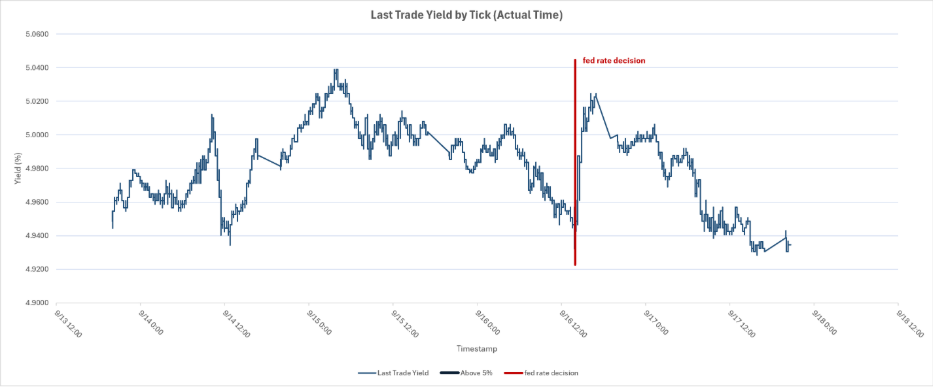
The two-year Treasury experienced the most pronounced post-meeting selloff, as investors responded to the prospect of another hike and to the broader tone of the press conference. Longer maturities also sold off initially, with the ten-year hitting 5.02% before more than retracing the move the next day with a weekly low of 4.93%.
The initial selloff reflected not just the hawkish tone but also the abbreviated road map that accompanied it. Guidance matters, especially at the long end, and leaving the market in the dark carries a price premium. By Thursday, investors appeared to have more fully digested the move and the degree to which the widely anticipated hike could calm some upward pressure on yields. For now, 5.00% is acting more as resistance for the ten-year rather than a new equilibrium.
Source: Bloomberg
Not Just the Fed
Ten-year Treasuries and FOMC decisions are bond-market headliners. But an important signal this week also came from the ten-year TIPS auction. This week’s auction cleared at a real yield of 2.65%, up from 2.44% in July and 2.17% in May. That progression shows the move is not simply a matter of inflation, pushing nominal yields higher. Real rates are elevated as well, reflecting a broader debate about the neutral rate, duration risk, and the amount of supply investors are being asked to absorb.
Yield Has Reasons to Stay
Yields are higher for a reason. Inflation, energy prices, geopolitical conflict, Treasury supply, corporate issuance from AI hyperscalers, and fiscal concerns continue to influence the long end of the market. The hike answered one question: how the Fed would respond to these forces. But the Fed alone cannot resolve them.
For investors, 5.00% may prove less like a brief milestone and more like a neighborhood. Even after Wednesday’s hike, the ten-year Treasury has reason to remain near 5.00%. That may be uncomfortable for consumers, taxpayers, and homebuyers. For bond investors, the same environment may present an opportunity. High-quality fixed income is offering income levels investors have rarely seen in recent years.
The challenge isn’t finding yield. It is deciding how to prudently capture it. This is when a diversified portfolio can lock in opportunity. Thoughtful positioning can help investors benefit from today’s yields while retaining the flexibility to respond to what comes next.
Trust, estate planning, insurance, and investment products are not a deposit, not FDIC insured, not insured by any federal government agency, not guaranteed, subject to investment risks, including possible loss of the principal amount invested and may go down in value. Any information and research contained herein do not represent a recommendation of investment advice to buy or sell stocks or any financial instrument nor is it intended as an endorsement of any security or investment, and it does not constitute an offer or solicitation to buy or sell any securities or investment services. This content is for informational purposes only and does not constitute legal or tax advice. Please consult your legal or tax advisor for specific guidance tailored to your situation. First Western Trust Bank cannot provide tax advice.

Insights
Week in Review: October 2, 2026
Overview Markets finished the week mixed as weaker employment data and more measured Federal Reserve commentary lowered expectations for an […]
Learn more
The Decisions That Become Harder as Wealth Grows
Financial success creates more options. It can provide greater flexibility, open new opportunities, and allow you to support the people […]
Learn more
Week in Review: September 25, 2026
Overview Markets saw another rise in interest rates last week as economic data reinforced the prospect that monetary policy may […]
Learn more
Scott Wylie on the Changing Colorado Banking Landscape
Colorado’s banking industry is undergoing significant change as consolidation reshapes the market and leaves many clients reconsidering what they want […]
Learn more
Week in Review: September 18, 2026
Overview Markets (S&P 500) ended the week effectively unchanged as investors considered the Federal Reserve’s first rate hike in over […]
Learn more
Ready to learn more?
Let’s have a conversation.
Embark on a banking experience tailored to your distinct path, focused on achieving personal and business financial prosperity.