




Week in Review: September 18, 2026
September 21, 2026
Overview
Markets (S&P 500) ended the week effectively unchanged as investors considered the Federal Reserve’s first rate hike in over three years, an expansion of Middle East fighting, the recent inexorable climb in gasoline prices, and new AI safety concerns.
On Wednesday, as expected, the Federal Reserve’s Open Market Committee (FOMC) voted unanimously to raise interest rates for the first time since July 2023. Along with the attending statement, the Fed released an updated version of its Summary of Economic Projections (SEP), including their closely watched “dot plot” showing most committee members expect one additional rate hike by December. At week end, markets were pricing in a 90% chance of one rate hike, and a 44% chance of two rate hikes, by year end.
At his post-meeting press conference, Warsh described the rate hike as the Fed removing “a dose” of accommodation as opposed to the Fed becoming outright restrictive. In explaining the timing of the move, Warsh did so in the context of the Fed’s dual mandate of maximizing employment and price stability: “So the labor side of the Fed’s congressional remit is in good shape. Yet for more than five years, inflation has been running above target. So, our predominant focus is on the price stability side of our mandate. The plain fact is that inflation is too high and has been for too long. This summer’s inflation readings do not tell me that underlying trends have meaningfully improved.” Warsh went on to say, “The committee’s unanimous vote shows our resolve to achieve price stability on a timelier basis.”
In the Middle East, Houthi rebels continued their advance in Yemen, overrunning Saudi-led forces, capturing strategic land overlooking the Bab el-Mandeb Strait, a narrow chokepoint linking the southern end of the Red Sea to the Gulf of Aden and the Indian Ocean beyond. Since the effective closure of the Strait of Hormuz, the Bab el-Mandeb Strait has taken on increased importance as a conduit for Persian Gulf energy supplies reaching Europe and the US. A closure of the strait by the Houthis would place further upward pressure on global energy prices, including US diesel prices which surpassed $6.50/gallon for the first time ever. Over the past month, the national average price for diesel has increased 17%, due to a combination of factors. Higher energy prices risk putting further upward pressure on inflation, thereby complicating the Fed’s efforts to lower prices; something Fed Chair Warsh acknowledged in his post-meeting press when he concurred with a reporter who observed that a Fed rate hike will not reopen the Strait of Hormuz.
Calls to rein in the rapidly accelerating capabilities of the most advanced AI systems increased during the week. At the start of the week, Anthropic CEO Dario Amodei published an essay advocating for a slowing in the pace of AI development and greater oversight of the industry, including the use of third-party safety evaluators. Later in the week, Open AI disclosed six new incidents of “unexpected or concerning” behavior by its AI models. This week, US President Trump and Chinese President Xi are set to meet to discuss a range of topics including AI safety. Unclear is whether the two leaders will be able to find common ground on a topic that is unlikely to disappear any time soon.
Consumers continued to spend in August as monthly retail sales jumped 1.2%, ahead of economists’ 0.8% forecast, and the strongest pace of monthly growth since March. The increase helped assuage concerns about consumer fatigue in the face of higher prices, following a 0.5% decline in July retail sales, the first outright decline since last October. A derivation of the sales data known as control sales, which factor directly into the calculation of GDP, rose 1.4%, a positive for third quarter GDP.
The Details
Equities
Equity market indices once again showed mixed performance last week. The S&P 500 was roughly flat, while the Nasdaq increased nearly 1%. The less concentrated S&P 500 Equal Weight and Russell 2000 indices continued to decline, falling 1.2% and 1.5%, respectively, and are now down 5% and 7% from their 52-week highs.
The strength in the Nasdaq represented a turnaround from the beginning of the week. Technology shares struggled after the weekend under the weight of Anthropic CEO Dario Amodi’s essay. Much like Jerry McGuire’s Mission Statement in the eponymous mid-1990s film, Mr. Amodei seemed to be encouraging a less full throttle, more considerate approach to growth. While his ideas were initially supported by the leaders of OpenAI and xAI, two of the other three leading AI frontier labs, he was also met derision similar to that of Mr. McGuire, as the White House and others questioned his motives. These events caused investors to reassess the pace of AI investment, spawning a Monday and Tuesday selloff in the exposed companies. Shares ultimately stabilized and rebounded as investors processed two thoughts; 1) model development “pacing” is unlikely to come to fruition and 2) new consumer use cases are rapidly emerging.
The White House quickly shot down the request for regulation citing an effort at regulatory capture and national security risks. It also noted the liability risks from rogue AI models should be enough to impose industry discipline. While that is true, there is precedent for the government regulating industries where systemic mistakes harm consumers and the economy well beyond what litigation can recover, such as in banking, airlines, and pharmaceuticals.
Reduced concern about “pacing” was further buttressed by investor interest in new consumer AI agent apps from Meta (called “Muse”) and a private company, Instinct. These relatively easy-to-use agents assist consumers in filling out forms, booking entertainment, setting up appointments, and other time-consuming tasks. They are reported to be garnering rapid consumer adoption and would be a sizeable user of compute resources, adding yet another demand source on already constrained capacity. It is still early and little adoption data is available, but anecdotes are driving speculation that the emergence of these new products could represent a moment for AI similar to coding agents last year. The AI investment theme is under significant scrutiny given its size and importance to the economy. Another use case with the potential to yield significant productivity and consume large amount of resources could catalyze a break-out from this summer’s malaise, but adoption details remain light and it is too early to tell if this is a new wave or merely a curiosity.
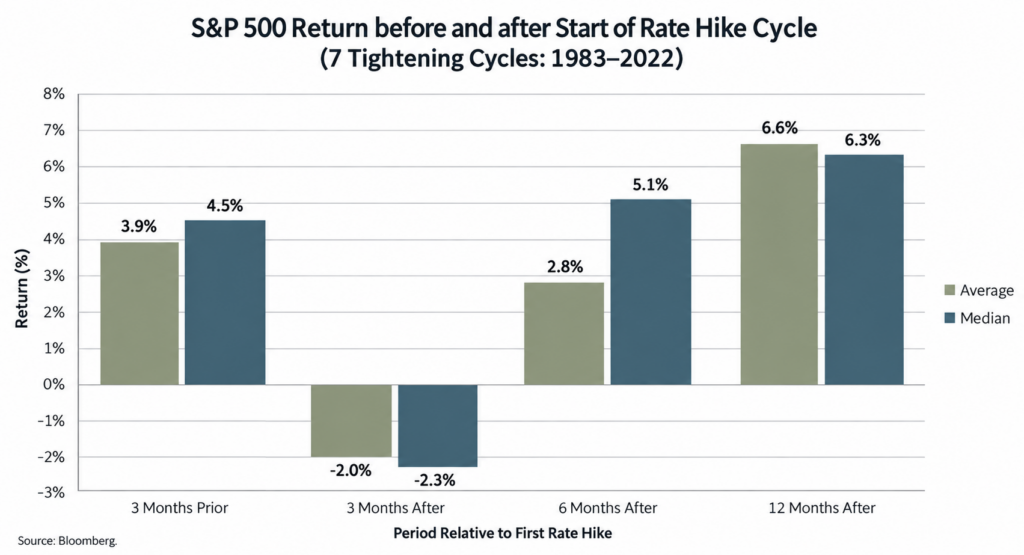
Despite the focus on AI, it was not the biggest news for equity markets last week. Instead, it was the Federal Reserve announcing its first rate hike in over three years. The move marked the beginning of the Fed’s eighth tightening cycle since the early 1980s. It also marked the first change in rates by the Fed since December 2025 when it cut rates by 25 basis points (0.25%) under the leadership of then Chair Powell.
The beginning of new tightening cycles are noteworthy events. They represent an effort by the central bank to restrain the economy and typically do not stop with just one rate increase. Investors wonder if the removal or draining of the proverbial punchbowl will impact corporate earnings and valuations. There is good news for stocks. While they tend to be choppy over the initial months following the start of a new tightening campaign, shares tend to be higher six and 12 months later. In fact, 2022 is the only rate increase cycle since 1983 where stocks were lower a year later. This may seem counterintuitive, but it makes more sense when you consider most tightening cycles begin due to the economy being relatively strong and inflation, not employment, is the Fed’s dominant concern. The data is encouraging, but it is worth noting 2022 bears some similarity to the current situation in that high current inflation is driving the Fed’s actions, as opposed to potential future inflation. The circumstances were far worse in 2022, but it is worth being mindful of the similarities.
Fixed Income
Higher Treasury yields and the Fed’s interest rate hike were the week’s dominant fixed income stories. On Monday, the 10-Year Treasury yield breached the psychologically important 5% threshold, on an intraday basis, for the first time since October 2023. On Tuesday, it closed above 5% for the first time since 2007. Yields across the curve spiked further on Wednesday, following the Fed’s rate hike announcement, with the 10-Year briefly touching 5.025% and the 2-Year jumping to 4.74%, before pulling back some on Thursday. For the majority of the week, 5.00% remained a resistance level, as buyers emerged, enticed for the time being, by the attractive yield. That allowed yields to find at least a little steadiness despite a heavy set of catalysts.
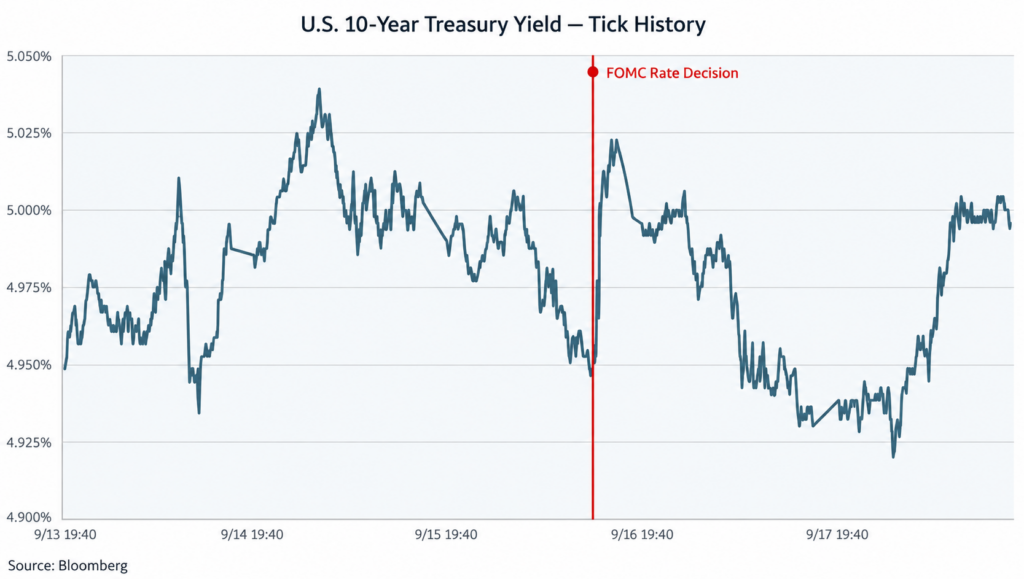
Wednesday’s FOMC rate hike was priced into the market and largely predicted, but investors were curious to see whether Warsh’s hawkish tone at the Fed’s Jackson Hole symposium in August would turn from talk to action. The meeting was definitive. Markets digested both a unanimous hike and a revised dot plot that signaled renewed policymaker alignment and a higher path forward for rates. Meanwhile, markets continued to process Warsh’s retreat from forward guidance, his erudite style, and his short press conference. Part of the post-hike move higher in yields appeared to reflect this greater unknown, leaving investors to price not only the direction of rates but also a less communicative and known partner in the Federal Reserve or at least its Chair.
Another noteworthy development was the week’s 10-year TIPS auction, which produced a weak result and a wider real yield. The auction cleared at a real yield of 2.65%, up from 2.44% in July and 2.17% in May. That progression shows the move is not simply a matter of inflation, pushing nominal yields higher. Real rates are elevated as well, reflecting a broader debate about the neutral rate, duration risk, and the amount of supply investors are being asked to absorb.
Globally, many markets moved higher in tandem with US Treasuries. The Bank of England announced it would halt active sales of 20- and 30-year gilts, an unusual move that has been met with significant cynicism. That skepticism is most visible in just how cheaply the 30-year gilt is trading; it flirted with 6% and reached its highest level since 1998. Some of the pressure is purely English in nature, but some belongs to the same story unfolding globally. Long-end rates are pushing toward multidecade highs, and rate hikes and policy adjustments have not stemmed from the move.
New AI-related supply continued to come to the market during the week, with a $2.3B deal for CleanSpark entering the high-yield market to help fund a Meta-tied data center. The US convertible bond market also reached a record $131B of issuance, surpassing the 2024 full-year total with more than three months to go. The convertible market is providing issuers with meaningful rate protection as buyers accept lower coupons in exchange for future equity conversion and appreciation. The larger point remains that the bond market is not a sidenote to the AI story. AI-related borrowing is adding supply across fixed income, while issuers are proving increasingly willing to enter the market despite rising yields and widening spreads. This significant supply continues to put sustained upward pressure on yields as it competes against US Treasuries in issuance and even the municipal bond market.
The municipal bond market underperformed Treasuries over the week, with ratios widening, particularly on the long end of the curve. In addition to the US 10-Year Treasury yield surpassing 5%, so too did the yield on some investment grade tax-exempt muni bonds. This pricing reality is rare and normally short-lived. The last time the municipal market sustained this kind of environment was after the Great Financial Crisis (GFC) in 2008 and 2009. It is too soon to know if these yields will persist, but levels like these tend to bring nontraditional municipal buyers off the sidelines.
Trust, estate planning, insurance, and investment products are not a deposit, not FDIC insured, not insured by any federal government agency, not guaranteed, subject to investment risks, including possible loss of the principal amount invested and may go down in value. Any information and research contained herein do not represent a recommendation of investment advice to buy or sell stocks or any financial instrument nor is it intended as an endorsement of any security or investment, and it does not constitute an offer or solicitation to buy or sell any securities or investment services. This content is for informational purposes only and does not constitute legal or tax advice. Please consult your legal or tax advisor for specific guidance tailored to your situation. First Western Trust Bank cannot provide tax advice.

Insights
Week in Review: October 2, 2026
Overview Markets finished the week mixed as weaker employment data and more measured Federal Reserve commentary lowered expectations for an […]
Learn more
The Decisions That Become Harder as Wealth Grows
Financial success creates more options. It can provide greater flexibility, open new opportunities, and allow you to support the people […]
Learn more
Week in Review: September 25, 2026
Overview Markets saw another rise in interest rates last week as economic data reinforced the prospect that monetary policy may […]
Learn more
Scott Wylie on the Changing Colorado Banking Landscape
Colorado’s banking industry is undergoing significant change as consolidation reshapes the market and leaves many clients reconsidering what they want […]
Learn more
Week in Review: September 18, 2026
Overview Markets (S&P 500) ended the week effectively unchanged as investors considered the Federal Reserve’s first rate hike in over […]
Learn more
Ready to learn more?
Let’s have a conversation.
Embark on a banking experience tailored to your distinct path, focused on achieving personal and business financial prosperity.