




Week in Review: September 25, 2026
September 29, 2026
Overview
Markets saw another rise in interest rates last week as economic data reinforced the prospect that monetary policy may remain restrictive for longer. The 10-Year U.S. Treasury yield, which had only recently crossed 5%, moved as high as 5.22% before finishing the week at 5.16%. Thirty-year mortgage rates also climbed above 7% for the first time since January 2025. Despite the pressure from higher rates, the Nasdaq reached a new record on Monday, aided by renewed hopes that diplomatic discussions could eventually ease tensions between the United States and Iran in a sort of Groundhog Day for geopolitics. The week also included a closely watched meeting between President Trump and Chinese President Xi Jinping. The two leaders discussed trade, artificial intelligence, and the broader relationship between the world’s two largest economies. The visit produced some modest tariff reductions, a short extension of the existing trade truce until January 10, and a schedule for further engagement. The meetings mostly preserved the status quo, with progress on harder issues put off for another day.
S&P Global Composite PMIs (a survey that asks respondents if business is getting better or worse) were released last week and revealed growth remains surprisingly strong. The reports paint a picture of broad economic strength and an economy that is not merely avoiding a downturn but continuing to expand at a strong pace. While it is good to have a strong economy, the degree of strength could sustain inflationary pressure and keep rates higher for longer.
For investors, the difficulty is that economic resilience itself is no longer an unambiguously positive development. Stronger activity supports corporate earnings and reduces recession risk, but it also gives the Federal Reserve greater latitude to continue raising interest rates, a potential negative catalyst for economic activity; and certain sectors in particular. Several Fed officials indicated during the week that additional hikes may be warranted, contributing to higher expectations for another increase in October. Consumer sentiment remained subdued, with the latest reading falling short of expectations and declining from the prior month, continuing the slight downward trend. The combination of strong business activity and cautious households presents a complicated picture: the economy remains durable, but consumers are increasingly conscious of higher borrowing costs and persistent price pressures.
The result is a market that remains resilient at the index level but is being asked to absorb an increasingly demanding rate environment alongside broader geopolitical complexities, interest rate risk, and inflation related uncertainty.
The Details
Equities
Equities continue to be mixed with the performance of the index diverging from that of the average stock. The S&P rose 1.2% this week, while the Nasdaq 100 continued its march upward, rising over 3%. The Equal Weighted S&P and Russell 2000 failed to keep pace yet again, falling 0.2% and 0.8%, respectively, which better reflects the experience of the average stock.
Equity market news was light last week, as companies tend to be quiet in the waning days of a quarter. However, attention hungry AI delivered again, with two events that offer fodder for both the bulls and bears of this story.
On the negative side, large software and data center operator, Oracle, announced it was declaring Force Majeure on portions of expected lease payments for a $165 billion data center project being developed in New Mexico, expected to come online in 2028. (Force Majeure refers to a clause in contracts that frees a party from an obligation due to circumstances outside its control.) Oracle is struggling to secure permits necessary to ensure the site will have power in 2028 and is declaring it should not be subject to higher lease rates until a later date than outlined in the contract. This news fed fear that the AI investment boom, which is largely powering the economy, could be slowed by permitting and other delays, particularly around power procurement. Oracle and related companies sold off on the day, but the rest of the market largely shrugged it off. However, it is a key issue to monitor with broader concern likely to grow quickly if there are more examples.
On the positive side, Meta held an event where its management team walked through its plans for its new “agent” for consumers, Muse. There continues to be a lot of buzz around this product and its potential to catalyze higher value use of AI by consumers. This would be very positive for the AI supply chain as any agent is compute intensive and thus supports significant investment. It remains too early to know if this is a passing curiosity or the beginning of a new wave, but enthusiasm is growing.
As the third quarter nears a close, it is a good time to assess overall stock market health. As summer wound down, concern grew typical September seasonal weakness could conspire with mid-term election uncertainty, testing of a new Fed Chair and the ongoing Iran war to pressure stocks during the fall. While this fear has not come to pass for the headline index levels, with the S&P and Nasdaq down only 1% from all-time highs, the average stock is falling prey to these concerns. Beneath the surface, the average stock is down 20% and 22%, respectively, from 52-week highs. For the smaller company focused Russell 2000 index, the average stock is down a more severe 29% from its 52-week high. While these measures alone are not sufficient to suggest a precarious market, given they are only modestly worse than the norm, the percentage of stocks trading above their 50-day and 200-day averages is declining rapidly and suggestive of weaker index health.
Divergence between the headline index level and underlying stocks tends to resolve with eventual downward pressure on the index level, but there are exceptions. Rotation across sectors by investors within the index can be one explanation. There is some evidence of this with utility and consumer discretionary stocks down 17% and 11%, respectively, from highs, while technology and healthcare shares are down only 1% and 3% from highs. Utilities tend to be rate sensitive and are thus likely reacting to higher long-term interest rates, while consumer discretionary shares are being impacted by higher fuel prices and higher rates, as housing related companies reside in this sector.
The economy and earnings remain strong, thus it is rational for investors to be generally comfortable with equities. With some discrete large headwinds in rates and energy prices, however, some shifting of exposure around within equities makes sense. Near-term volatility would not be surprising, but there remains solid fundamental underpinnings for the equity market.
Fixed Income
The bond markets continued selloff was dramatic this week. Resistance at 5.00% on the 10-year Treasury disappeared, and yields lurched higher from there, with each retracement and round of renewed buying ultimately giving way to further selling. The 5-year Treasury crossed 5% on Wednesday and the 30-year hit its highest yield since 2004, reaching 5.47%. A Bloomberg survey of market participants found that more than half of respondents expect the 30-year yield to reach 6% before year-end. The global bond market selloff has significant momentum. The prevailing sentiment is that rates are climbing and are not done yet. A market pricing in “higher for longer” raises two very real questions: how high, and how long?
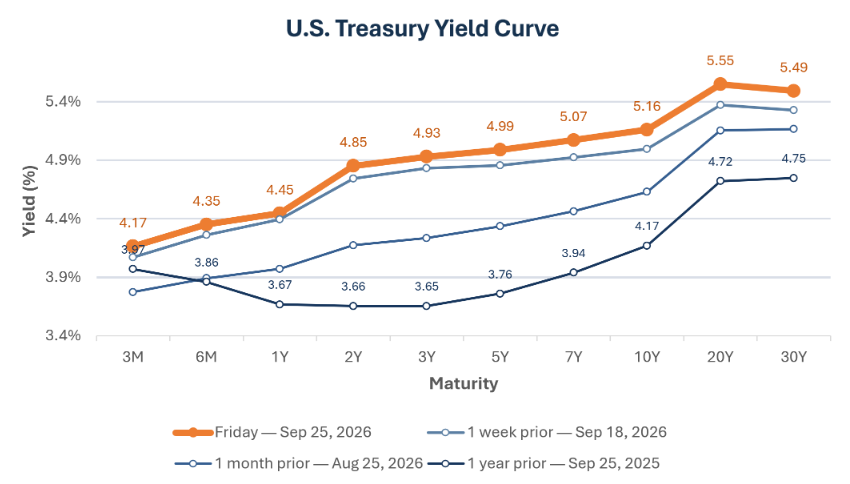
Source: Bloomberg generic U.S. Treasury yields (PX_LAST). Comparison dates are same-date snapshots.
The list of data points from across global bond markets is long, but each tells the same story: this week’s moves were significant and extensive. The average yield of sovereign debt globally passed 4.00%, a level not seen since 2007. Against the week’s more conspicuous milestones, this may be the more consequential one: a global cost of capital above 4% changes the equation for borrowers, investors, and policymakers alike. The JGB 10-year surged 10bps to 3.075% Thursday, its highest yield since 1996. The 30-year Bund closed at 3.91% on Friday, its highest since 2011. 30-year Gilts closed Friday at 5.88%, and some English banks were reportedly borrowing the at overnight rate and buying gilts to pocket spread – now well over 100bps. Stories are emerging across the market that indicate both distress and opportunity in this yield environment.
Additional rate hikes stayed front-of-mind this week. The market is now pricing in a 73% chance of a Fed hike in October, up from 60% the week prior. The ECB has over 100 bps of additional hikes priced-in over the next 13 months. Multiple Fed officials spoke and indicated that additional hikes might be necessary, with Beth Hammack cautioning against a settling in of an “inflationary mindset”.
The IG corporate market forecasted $40 billion in new issues for the week, already a light week compared to the rest of the calendar year. That number missed by over $13 billion because once Wednesday’s dramatic selloff included the 5-year treasury at a 5%, issuers chose to wait. Syndicate desks piece together weekly volume forecasts from informal issuer conversations that carry no commitment. Those forecasts are still useful to the market, but issuers can pivot as conditions change without signaling concern about their own credit or damaging their reputations. Thursday saw a single issuer come to market, pricing a 5-year bond at a yield above 8% to get the deal done, and Friday saw nothing at all. Company borrowers have not been sensitive to higher rates in 2026 because the AI buildout demanded it and investors kept showing up. This week was the first real evidence that there is a price at which even the most motivated borrowers blink — and that price appears to be somewhere around a 5% 5-year Treasury.
The municipal bond market once again underperformed treasuries over the week. The 10-year ratio went from 75.2% to 77.3%. Significant thresholds were crossed on Wednesday, with 10-year AAA municipals reaching 4.01% and 30-year AAA municipal benchmark reaching 5.07%. Those are levels that haven’t been seen since 2011. Shorter-maturity bonds were hit even harder than long ones, which is unusual and reflects how quickly the market repriced its expectations for Fed policy. September is shaping up to be one of the worst months for munis in recent memory, with losses of close to 3% for the month. It is also worth noting that the largest muni Chapter-11 filing in decades happened on Thursday. Brightline, which operates rail service in Florida, filed after what has long been a distressed and well-watched credit degradation. While not specifically related to the recent selloff, it added additional stress to the municipal markets over the week.
Trust, estate planning, insurance, and investment products are not a deposit, not FDIC insured, not insured by any federal government agency, not guaranteed, subject to investment risks, including possible loss of the principal amount invested and may go down in value. Any information and research contained herein do not represent a recommendation of investment advice to buy or sell stocks or any financial instrument nor is it intended as an endorsement of any security or investment, and it does not constitute an offer or solicitation to buy or sell any securities or investment services. This content is for informational purposes only and does not constitute legal or tax advice. Please consult your legal or tax advisor for specific guidance tailored to your situation. First Western Trust Bank cannot provide tax advice.

Insights
Week in Review: September 25, 2026
Overview Markets saw another rise in interest rates last week as economic data reinforced the prospect that monetary policy may […]
Learn more
Scott Wylie on the Changing Colorado Banking Landscape
Colorado’s banking industry is undergoing significant change as consolidation reshapes the market and leaves many clients reconsidering what they want […]
Learn more
Week in Review: September 18, 2026
Overview Markets (S&P 500) ended the week effectively unchanged as investors considered the Federal Reserve’s first rate hike in over […]
Learn more
Take a Hike
The Fixed Income Fix by Marian Cieslak The Federal Reserve raised interest rates for the first time in more than […]
Learn more
September 2026 Market Commentary
The dog days of summer. The term conjures images of hot, oppressive days that sap one’s energy, creating a sense […]
Learn more
Ready to learn more?
Let’s have a conversation.
Embark on a banking experience tailored to your distinct path, focused on achieving personal and business financial prosperity.